How Fast Is Fast Enough? Page Speed Benchmarks that Impact Your SEO in 2025

If you’ve ever been frustrated enough by a slow-loading page to leave a website completely, you already have an idea of why page speed benchmarks are important for SEO. In 2025, businesses are already facing enough challenges with changes in how search engines are ranking websites and using AI overviews (AIOs). Paying attention to how user-friendly your website is by focusing on page speed helps you increase conversion rates and maintain an edge on the competition. The San Diego SEO experts at Saba SEO explain how below.
Understand the Connection Between Page Speed and AIOs
Click-through rates from organic SERPs are falling for many company websites. But you don’t have to let this ruin your company’s sales this year. First, improving page speeds ensures members of your company’s target audience aren’t deterred from visiting your website by slow-loading pages. But AIOs are also more likely to highlight businesses that have user-friendly websites. Finding ways to use AIOs to your company’s advantage helps you overcome this challenge, and good page speeds are one way to hit this goal.
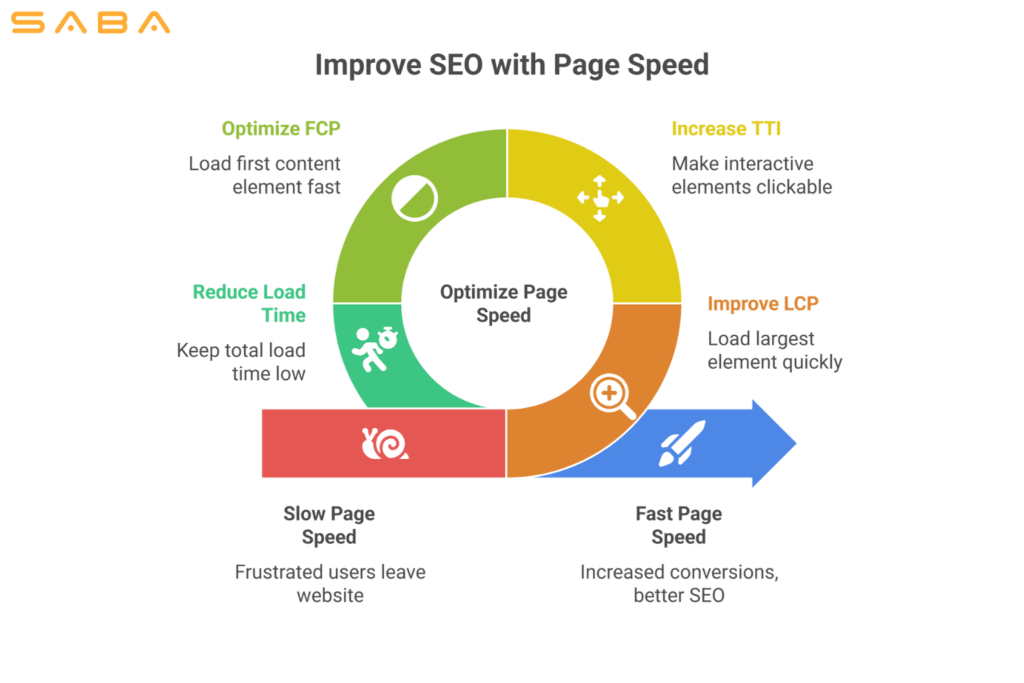
Pay Attention to the Largest Contentful Paint (LCP)
Don’t be intimidated by this complicated name. But you’ll want to note this is one of the most significant metrics SEO companies use for assessing page speed. This metric covers how long it takes for the largest element on the user’s screen to load. For most pages, this will be the main heading. These often include high-resolution images or animations that simply take longer to load than other components.
Increase Click Rates with Improving the Time to Interactive (TTI) Metric
Just because users can see the page doesn’t always mean they can use it. Interactive elements allow your website’s visitors to click buttons to add items to the cart or navigate to another page. Since keeping people on your website improves SEO rankings, making sure users don’t get put off by non-clickable buttons and links keeps them shopping or hunting for more information.
Look at the First Contentful Paint (FCP) Metric
This metric is very similar to LCP, but it only pays attention to how long it takes the first element of the content on your website to load. For most company websites, this will be a piece of text or an image. This might even be the background image. Images with large file sizes could impact the page speed, but this is often easily correctable.
Know the Load Time
This is the amount of time it takes to completely load the page with full visibility. Although there isn’t a set amount of time you want to aim for, it’s best to make sure this metric is as low as possible. As you may already know, people’s attention spans are short online. Keeping the total load time under two seconds is best. But experienced SEO professionals can often reduce this metric even more.
If you need help with any aspect of search engine optimization, turn to Saba SEO. As one of the leading digital marketing companies in San Diego, we have more than 20 years of experience in SEO, web design, and content development. Our experts use a variety of ethical SEO tactics to increase our clients’ online visibility, search engine rankings, and conversion rates. Whether you need a review of your existing digital marketing plan or a new SEO strategy, give us a call today.